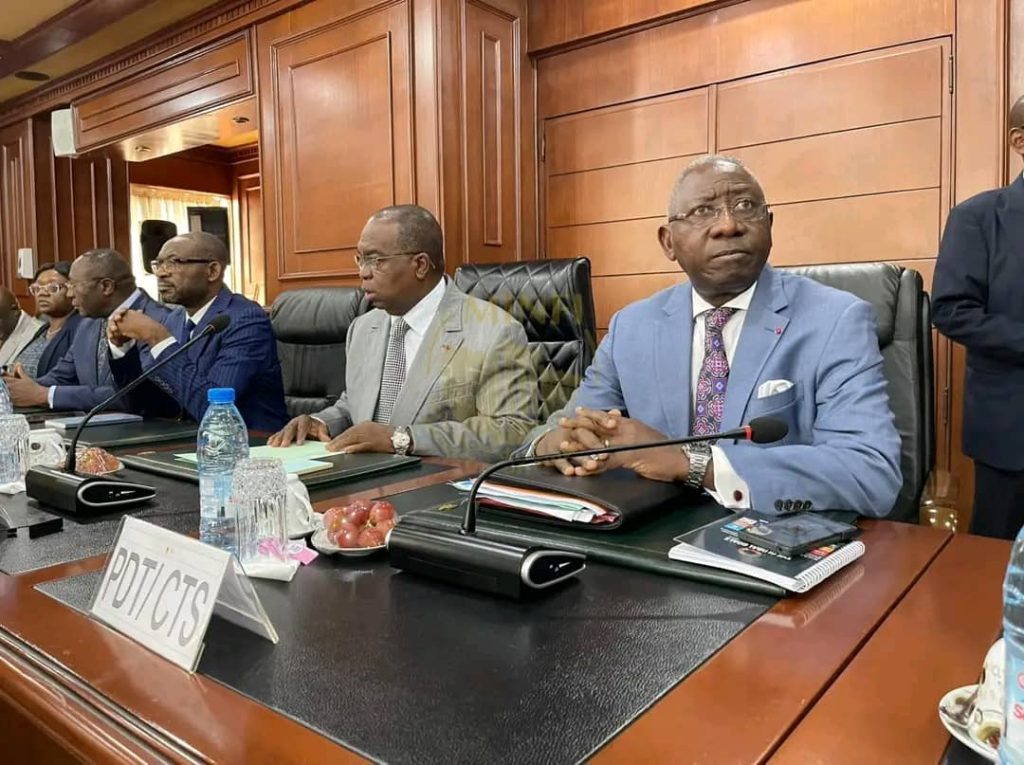
Yaoundé, Cameroon — Cameroon and the International Monetary Fund (IMF) are maintaining dialogue on the country’s economic outlook, fiscal policy and structural reforms as the government seeks to strengthen economic stability while supporting growth.
The continued engagement comes against the backdrop of the IMF’s 2026 Article IV consultation, which examined Cameroon’s economic performance and policy priorities. The discussions highlighted the challenge of balancing fiscal sustainability with the need to unlock stronger growth and employment in an uncertain environment.
The IMF currently projects Cameroon’s real gross domestic product (GDP) growth at 3.3 percent in 2026, with inflation expected to remain relatively contained. At the same time, the Fund has identified several risks, including exposure to volatile commodity prices, fiscal pressures and policy uncertainties within the Central African Economic and Monetary Community (CEMAC).
Fiscal consolidation remains central
One of the key issues in the Cameroon–IMF dialogue is the management of public finances.
The IMF's latest assessment indicates that Cameroon has made progress in reducing its debt-to-GDP ratio through fiscal consolidation. However, the country remains at high risk of debt distress, largely because of liquidity pressures and vulnerabilities associated with external debt. The IMF nevertheless assesses Cameroon's debt as sustainable under its baseline scenario.
The Fund has also pointed to weaknesses in domestic revenue mobilisation. Preliminary estimates for 2025 showed that the non-oil primary deficit was higher than the government's budget target, reflecting weaker-than-expected non-oil revenues and higher current expenditure.
For the government, this places greater emphasis on improving revenue collection while maintaining control over expenditure and protecting priority investments.
Growth and public investment
The IMF's assessment also places emphasis on the need to raise Cameroon’s productive capacity.
The Fund identifies infrastructure gaps, a relatively shallow financial sector, weaknesses in some state-owned enterprises and regulatory barriers as factors constraining growth. Addressing these structural challenges could help create conditions for stronger private-sector activity and employment.
Higher public investment is expected to contribute to the projected recovery in growth in 2026. But the challenge for policymakers is to ensure that investment spending is compatible with available fiscal resources and does not add unnecessarily to debt pressures.
This balance is likely to remain an important part of the economic discussions between Yaoundé and the IMF.
External pressures
Cameroon’s economic position is also influenced by developments beyond its borders.
The IMF estimates that the country's current-account deficit widened to 3.9 percent of GDP in 2025, partly because of declining oil export receipts. The Fund expects the deficit to widen further in 2026, partly reflecting weaker cocoa prices.
As a major economy within CEMAC, Cameroon also plays an important role in the region's external stability. The IMF noted that Cameroon’s contribution to regional international reserves remained broadly unchanged in 2025, despite the deterioration in its external position.
These developments make export diversification, stronger domestic production and prudent management of external financing important components of the country's medium-term economic strategy.
Looking beyond the previous programme
The current dialogue also takes place after the conclusion of Cameroon’s previous IMF-supported programme.
The IMF Executive Board completed the eighth review under the Extended Credit Facility and Extended Fund Facility arrangements, together with the third review under the Resilience and Sustainability Facility, in July 2025. I
The subsequent 2026 Article IV process represents a different form of engagement: rather than being a programme review, it is part of the IMF's regular economic surveillance of member countries.
Whether Cameroon eventually seeks another IMF-supported programme would depend on discussions between the authorities and the Fund. The existence of continuing economic dialogue should therefore not, by itself, be interpreted as confirmation of a new financing agreement.
A delicate policy balance
For Cameroon, the central economic challenge is increasingly one of balancing competing priorities.
The authorities need to preserve fiscal and debt sustainability while financing infrastructure and development priorities, improving public services and creating conditions for private-sector-led growth. At the same time, the economy remains exposed to fluctuations in commodity prices and other external shocks.
The IMF has called for prudent fiscal policies, the rebuilding of buffers and continued structural reforms to strengthen growth and resilience.
The continuing Cameroon–IMF dialogue is therefore likely to remain closely watched by investors, businesses and economic policymakers. Its significance will ultimately depend not only on the recommendations emerging from the discussions, but also on how those recommendations are translated into budgetary decisions and economic reforms.
For Yaoundé, the immediate task is to maintain economic stability while creating greater room for investment and sustainable growth. For the IMF, the engagement provides an opportunity to assess how Cameroon is navigating the fiscal, debt and structural challenges identified in its latest economic assessment.
#legitcameroon#