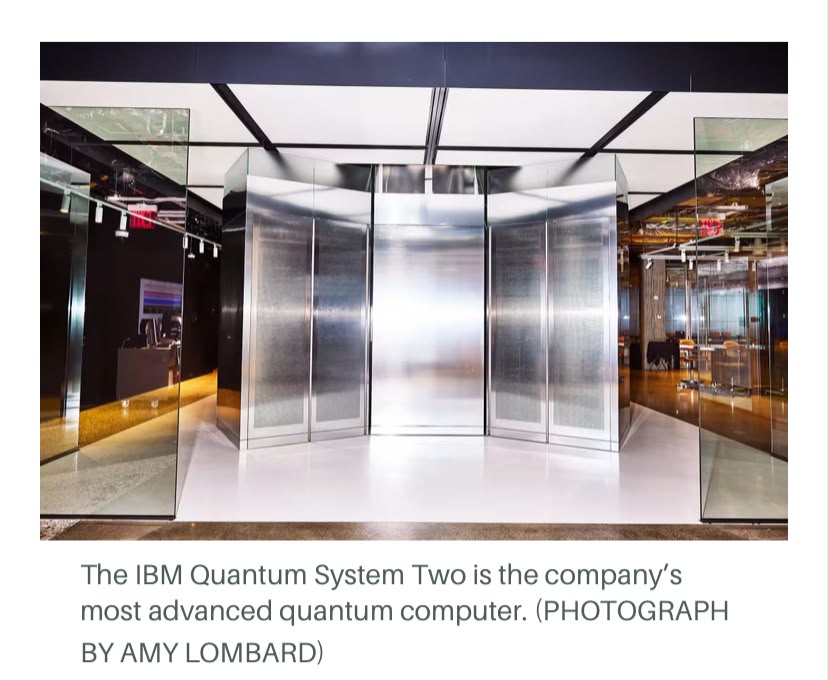
NEW YORK — Quantum computing is attracting renewed attention as technology companies, governments and researchers explore applications that could eventually transform areas such as medicine, logistics, cybersecurity and scientific research.
Recent developments have increased interest in the technology, which uses principles of quantum mechanics to process information differently from conventional computers.
IBM’s Nighthawk processor, for example, has been highlighted for completing a task in seconds that would take a conventional supercomputer an extremely long time under the comparison reported by Barron’s.
Major technology companies and specialised quantum-computing firms are investing heavily in the field, while governments are also supporting research and infrastructure.
Despite the progress, quantum computing remains an emerging technology. Researchers continue to face challenges involving error correction, stability and scaling quantum systems.
The technology is therefore not expected to immediately replace conventional computing. Instead, researchers are exploring how quantum systems could eventually work alongside traditional computers to solve particular problems that are extremely difficult for today’s machines.
As investment continues, quantum computing is increasingly being viewed as one of the major technologies to watch beyond the current artificial-intelligence boom.