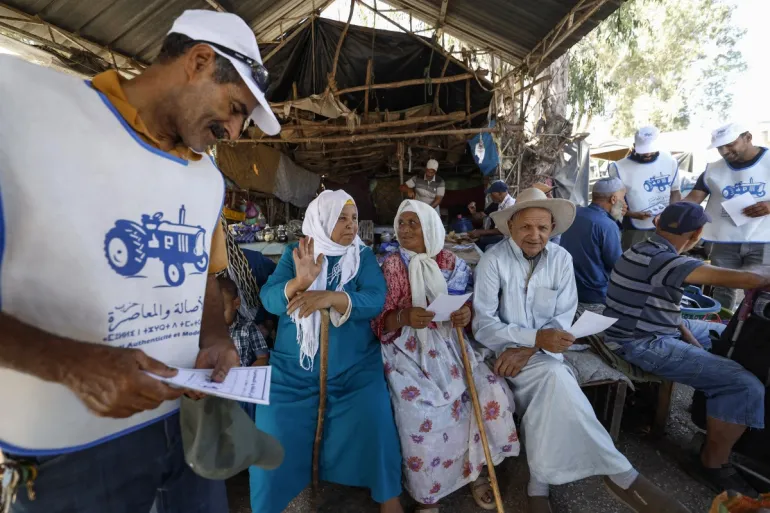
Morocco Youth Takes Center Stage Ahead of Election
RABAT, Morocco — Young people are emerging as a central focus of political campaigning in Morocco ahead of the country’s parliamentary election on September 23, with unemployment, housing, living costs and public services dominating concerns among a generation increasingly questioning its relationship with politics.
Morocco’s election campaign, which began on September 10, is bringing renewed attention to the participation of young voters. Twenty-seven political parties are competing for 395 seats in the House of Representatives, with more than 15.8 million voters registered for the poll. AAl Jazeera
Yet the figures surrounding young voters highlight a major challenge for political parties. According to official figures cited by Reuters, people aged 18 to 24 represent about 12 percent of Morocco’s population but only around 3 percent of registered voters.
Youth unemployment remains a major concern
For many young Moroccans, the election comes against a difficult economic backdrop.
Youth unemployment stands at around 27 percent, according to figures cited by Reuters, while approximately one in three young Moroccans is neither working, studying nor receiving training.
The situation has made employment one of the most prominent issues in the campaign. The National Rally of Independents (RNI) and the Authenticity and Modernity Party (PAM) have both placed youth employment at the centre of their campaign messages, with pledges to create about one million jobs during the next parliamentary term.
The parties have also highlighted infrastructure investment linked to Morocco’s preparations for the 2030 FIFA World Cup, which the country will co-host with Spain and Portugal.
For young people seeking stable employment and improved living standards, the question is increasingly whether national economic growth can translate into opportunities in their own communities.
A growing gap between economic growth and public satisfaction
Morocco has recorded major investment in sectors including manufacturing, ports, railways, phosphates and renewable energy. The country's New Development Model also sets an ambitious target of doubling GDP per capita by 2035. RReuters+1
But economic progress has not necessarily produced greater satisfaction among young citizens.
Morocco's central bank has pointed to a gap between objectively measured economic performance and citizens' perceptions, with persistent unemployment among the factors contributing to that divide, according to Reuters.
This disconnect is particularly significant for younger Moroccans, who are entering the labour market while facing high unemployment and concerns over the cost of living and access to public services.
Political trust under pressure
Beyond jobs and income, political trust is another major issue ahead of the vote.
An Afrobarometer survey published in March found that only about one-third of Moroccans aged 18 to 35 expressed trust in Parliament, the head of government or political parties. At the same time, young Moroccans were more likely than older citizens to post political content on social media and participate in demonstrations.
The figures point to a complicated relationship between young people and politics. Low electoral participation does not necessarily mean that young Moroccans are politically disengaged. Instead, social media activity and street demonstrations indicate that many remain actively interested in issues affecting their lives.
Political parties turn to younger voters
With youth concerns becoming increasingly prominent, political parties are using both traditional campaigning and social media to reach younger audiences.
RNI and PAM have emphasized employment, housing and income in their campaign programmes and have used social media to reach younger voters.
The approach reflects a wider recognition that younger Moroccans are an important constituency, even as relatively few are currently registered to vote.
The challenge, however, is rebuilding confidence in electoral politics.
Some young voters interviewed in recent reporting have expressed skepticism about whether elections can deliver significant changes in their everyday lives. Analysts cited by Reuters have also pointed to the structure of Morocco's political system, in which the monarchy retains substantial influence over the country's broad policy direction.
From social media activism to the ballot box
Young Moroccans have increasingly used digital platforms to express political and social concerns. The youth-led demonstrations of 2025 brought issues including education, healthcare and public services into the national conversation. Reuters reported at the time that the movement known as GenZ 212 mobilized young people through platforms including TikTok, Instagram and Discord. R
That history of activism has added another dimension to the 2026 election.
The question is not simply whether young Moroccans are interested in politics. It is whether that interest will translate into participation through established political institutions.
For political parties, convincing young citizens that voting can influence policies affecting employment, housing, education and public services remains a significant challenge.
Morocco youth election becomes a test of political engagement
As Morocco approaches September 23, the country's young population is therefore taking center stage in the electoral debate.
Political parties are making promises on jobs and economic opportunity, while young citizens continue to raise questions about public services, purchasing power and their prospects for the future.
The election will provide an important measure of how effectively political parties can engage a generation that is increasingly vocal online and in public spaces but remains comparatively underrepresented among registered voters.
For Morocco's youth, the central issue is likely to remain practical: whether political promises can translate into better opportunities, more affordable living conditions and a stronger sense of participation in the country's future.
#legitcameroon